Factcheck: Did climate change contribute to India’s catastrophic ‘glacial flood’?
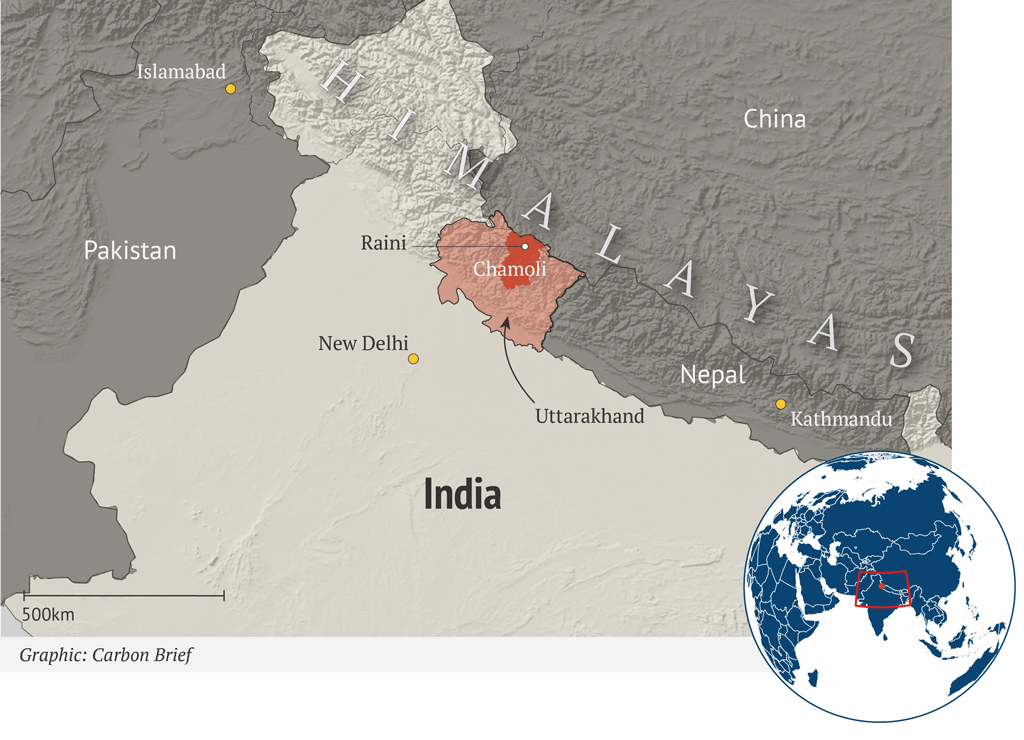
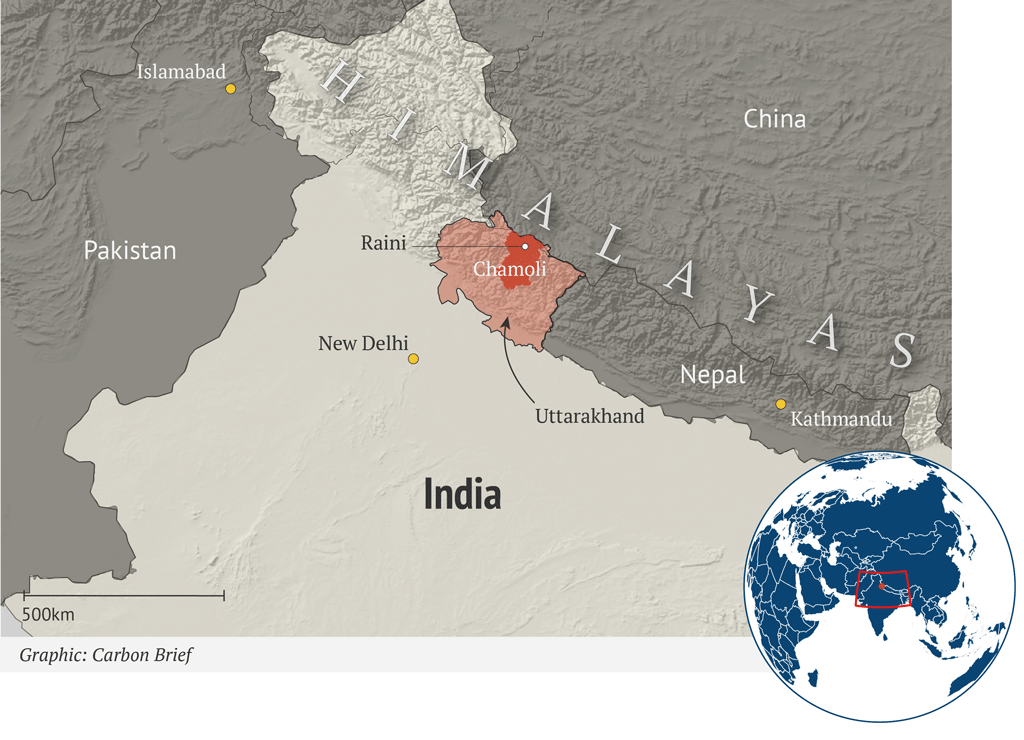
On Sunday 7 February, a sudden flood devastated a Himalayan valley in the Indian province of Uttarakhand. It tore through two hydroelectric dams, killing dozens of people and trapping hundreds more in construction tunnels.
With rescue efforts still underway, the disaster has swiftly become international news.
Media coverage has speculated about the cause of the devastation, with glacial lake “outbursts”, broken glaciers and avalanches all put forward as possible explanations.
In this factcheck, Carbon Brief unpacks how the events unfolded and speaks to scientists who suggest that a landslide was, in fact, the most likely primary cause.
And while further analysis is needed to assess the role of climate change, one scientist tells Carbon Brief that rising temperatures are causing “more of these big slope collapses”.
What happened?
According to police in Uttrakhand, the flood hit around 05:30GMT (11:00 local time). The torrent of water, ice and debris first destroyed the Rishiganga hydroelectric project – a small dam of roughly 13.2MW. BBC News reported that “the impact catapulted water along the Dhauliganga river” where it hit the much larger 520MW Tapovan Vishnugad hydropower construction project 5km downstream.
The floodwater was first noticed by residents of Raini village, which sits 3,700km above sea level, who filmed videos on their phones. The fast-flowing flood water swept away bridges, roads, homes and livestock, forcing officials to hurriedly evacuate villages along the banks of the Alaknanda and Dhauliganga rivers.
The district of Chamoli in Uttarakhand was hit hardest by the Dhauliganga flooding, with the village of Raini at the centre of the event. “It came very fast, there was no time to alert anyone,” Sanjay Singh Rana, who lives on the upper reaches of the river in Raini village, told Reuters: “I felt that even we would be swept away.”
The country’s disaster response team has been airlifted in, alongside hundreds of soldiers and members of the Indo-Tibetan border police. Two-and-a-half thousand people in 13 villages were cut off by the floods, but rescuers have now reached all 13 villages and relief work is underway.
When the flood hit, 35 people were working on the Rishiganga project and 176 people on the Tapovan Vishnugad project. According to the Guardian, 171 people have been reported missing and 26 dead – mainly construction and dam workers. According to a senior government official, many nearby residents work at the Dhauliganga plant, “but as it was a Sunday fewer people were at work than on a weekday,” the Associated Press reported.
Monday’s rescue operation focused on a 2.4km tunnel beneath the Tapovan Vishnugad hydropower dam, in which 39 workers were believed to be trapped. On Monday evening, at least 18 workers were rescued. Earlier, 12 workers who were building service tunnels were rescued from a smaller tunnel beneath the Tapovan-Vishnugad dam.
However, many more workers are still believed to be trapped in tunnels that have been blocked off with debris. Excavators are tunneling through the debris to reach them, but many are feared to be dead as no contact has yet been made with anyone in the tunnel.
Many outlets are concerned that this is reminiscent of floods in Uttarakhand in 2013, when several days of heavy rain washed away villages and killed almost 6,000 people.
Video of 2021’s Chamoli flood. Source: The New York Times.What triggered the event?
In the immediate aftermath of the floods, initial reports suggested that a “glacial lake outburst flood” was a possible cause of the event.
Glacial lakes form behind natural dams created by debris collected at the front of glaciers and then left behind as glacier fronts retreat. As a Carbon Brief guest post from last year explained, thousands of such lakes around the world are expanding as glaciers melt in response to rising temperatures.
If the natural dam breaks, glacial lakes can cause potentially catastrophic outburst floods. According to one study, these floods have become “emblematic of a changing mountain cryosphere”.
The Indian Express, for example, reported that “scientists are not sure what triggered the sudden surge of water…[but] the scenario being most talked about was what glaciologists like to call a GLOF, or glacial lake outburst flood”.
In some cases, media reports suggested that a broken piece of a glacier could be a factor. CNN said “part of a Himalayan glacier fell into a river sending a devastating avalanche of water, dust and rocks down a mountain gorge, and crashing through a dam”. USA Today had a similar line in their reporting. While the Times of India reported that an “abrupt snowslide” could have been the cause.
(BBC News, Al Jazeera, CNN and USA Today all mentioned a “glacier burst” in their headlines, which one expert describes as “not a thing”.)
The remoteness of the area “means no-one has a definitive answer, so far”, said BBC World Service environment correspondent Navin Singh Khadka.
However, the Independent reported that “experts have also theorised that an initial landslide may have been the cause”.
This was supported by an American Geophysical Union (AGU) blog penned by the University of Sheffield’s Prof Dave Petley, which pieced together the weekend’s events with the help of other experts on Twitter.
Using daily satellite imagery, Petley explained that a “block of rock, with some ice, dropped from about 5,600 metres to about 3,800 metres, a fall of almost two kilometres, before impacting on the valley floor”. This “will have instantly fragmented to generate a huge rock and ice avalanche, which travelled down the glacier. This would have been extremely fast and very energetic,” he added.
The gif below, which shows the before and after satellite imagery of the valley, highlights the section of rock and ice that fell.
This rock avalanche “will have generated a huge amount of heat”, Petley continued, which will have incorporated glacier ice – “crushed and melted” – into the flow, creating a “debris flow”. He added that “the movement of the landslide was so rapid that the debris flow pushed water from the river ahead of it before incorporating it”. This can be seen in the clip below:
#Breaking A massive sudden floods in Dhauliganga after a huge Himalayan glacier collapse in Reni village in Uttarakhand which destroyed many river bankside houses now. This is real #ClimateEmergency.
My thoughts & prayers with the people of Uttarakhand.

Advertising by Adpathway







;)