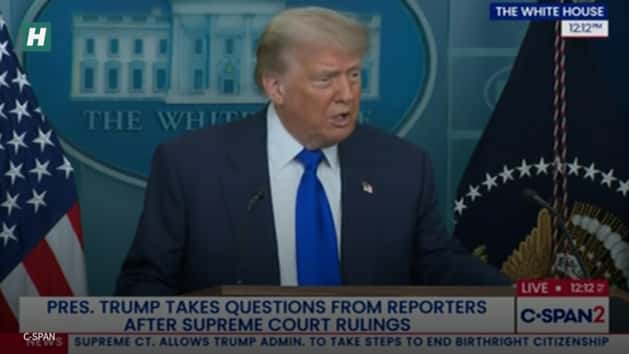
WASHINGTON – The federal government could have to change how it issues Social Security numbers now that the Supreme Court has said President Donald Trump’s order ending birthright citizenship can take effect outside of specific cases where it’s been blocked by a lower court.
For decades, whenever a baby is born in the U.S., hospitals have notified state vital records agencies, which have in turn notified the Social Security Administration, that a new person needs a Social Security number. The so-called “enumeration at birth” policy is automatic for the government and simple for parents, who merely check a box on a hospital form.
Trump’s order, if it takes effect in 30 days, could make the process more complicated, though neither the Social Security Administration nor the White House responded to requests for comment Friday about how it could change.
Nancy Altman, president of Social Security Works, a liberal advocacy group that opposes benefit cuts, said the Supreme Court decision, allowing at least partial implementation of Trump’s birthright directive, could create “widespread chaos” and require more Americans to visit Social Security field offices in order to get Social Security numbers for their babies.
The order forbids federal agencies to accept or issue documents recognizing citizenship to babies whose mothers are not lawfully present in the United States. The text describes exactly the sort of sending and receiving of documents that occurs through the enumeration at birth process.
“It is the policy of the United States that no department or agency of the United States government shall issue documents recognizing United States citizenship, or accept documents issued by State, local, or other governments or authorities purporting to recognize United States citizenship, to persons: (1) when that person’s mother was unlawfully present in the United States and the person’s father was not a United States citizen or lawful permanent resident at the time of said person’s birth, or (2) when that person’s mother’s presence in the United States was lawful but temporary, and the person’s father was not a United States citizen or lawful permanent resident at the time of said person’s birth.”
The order specifically mentions Social Security and gives agencies 30 days to issue public guidance about how it would be implemented.
The Supreme Court’s decision did not address the constitutionality of the order, which is plainly contrary to the citizenship clause of the 14th Amendment, but rather the practice of lower courts issuing nationwide injunctions, like the ones several federal judges imposed blocking the birthright order from taking effect. The court said the injunctions can remain, but only to the extent they “provide complete relief to each plaintiff with standing to sue.” It’s likely there will be lots more plaintiffs, class action cases and additional injunctions that could cover wide geographic areas.
To the extent the order takes effect, in Altman’s telling, the Social Security Administration will have to track court cases and devise some way of determining which babies are eligible for enumeration and which aren’t, and that doing so could be extremely difficult.
“It might mean that SSA simply ends its enumeration at birth program, costing huge amounts of money, causing huge inconvenience, and swamping already overwhelmed field offices,” Altman said.
Canceling or curtailing Social Security’s enumeration at birth program would likely cause a public backlash, one that the Trump administration might like to avoid, since it’s the way 99% of babies have received their Social Security numbers since the 1990s.
In March, the Social Security Administration canceled vital records contracts with the state of Maine in an act of political retaliation against Maine’s Democratic governor. The state notified parents they would have to visit Social Security field offices to get their kids’ Social Security numbers, prompting an outcry that forced Social Security to quickly reinstate the contracts.








;)