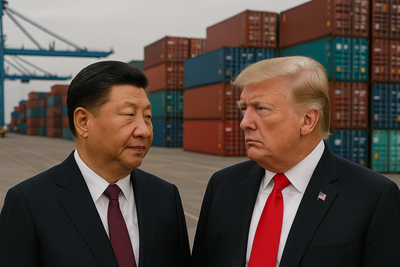
'Useful idiot': Inside China’s long game - How Xi is squeezing Trump over trade
China believes momentum is on its side because Trump has a stronger desire to sign a deal with Beijing so that he can claim victory and secure a summit with Xi in the fall.
William Yang, the International Crisis Group’s senior North East Asia analyst, to Bloomberg
- As the Economist report says, Beijing’s new playbook centers on weaponizing upstream choke points - rare earths, magnets, battery materials and precision tools - to squeeze Western (and especially US) supply chains while protecting its own.
- China’s supply-chain choke points are not just a bargaining chip - they are a strategic weapon that can be switched on or off without warning, directly targeting US industries, military readiness, and allied economies.
- The “China squeeze” reveals a shift in the balance of trade power: instead of threatening to buy less from America, Beijing is threatening to stop the world from making things it needs.
- For the US, that means the defense industry can’t count on steady supplies of rare-earth magnets, advanced alloys, or specialty electronics - vulnerabilities China can exploit in any geopolitical flashpoint, from Taiwan to the South China Sea.
- For allies, it exposes how interwoven global manufacturing is with Chinese inputs - and how fragile diversification efforts remain. A single export-license slowdown can ripple from iPhone production in India to missile assembly lines in Texas.
- For Trump, it undercuts the premise that tariffs alone can bring Beijing to heel.
- For global markets, it signals a playbook that blends statecraft with market manipulation - and one that other resource-dominant nations may be tempted to copy.
- In short: Xi’s economic arsenal isn’t about winning one round of tariffs - it’s about making sure China holds the valve on the parts of the global economy the US and its allies can least afford to lose.
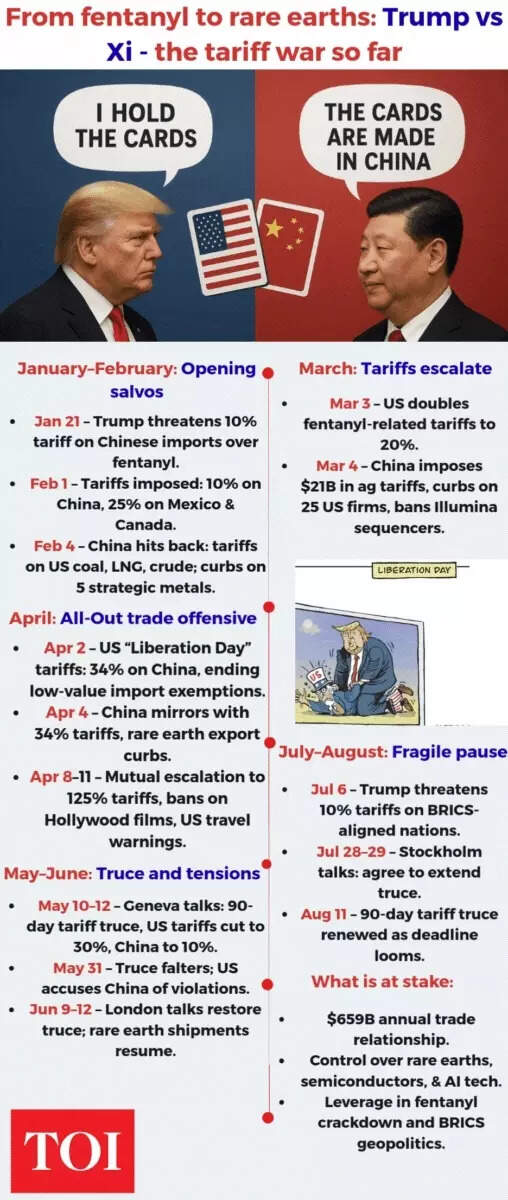
Trump vs Xi: The tariff war timeline
- US trade representative Jamieson Greer told Bloomberg the talks are “about halfway there” on restoring magnet flows after China’s export controls, adding the aim is that magnets “can flow as freely as it did before the control.”
- Xiang Lanxin (National University of Singapore) told the Economist, “Beijing was not surprised to find it has leverage, but it must be used discreetly.”
- Wu Xinbo of Fudan University told CNN the flow could be dialed up or down: “If the bilateral relationship is good, then I’ll go a bit faster; if not, I’ll slow down.”
- William Yang of the International Crisis Group cautioned that “Beijing will be happy to keep the US‑China negotiation going, but it is unlikely to make concessions.”
- $659 billion: the two‑way annual trade in goods
- 90%: China’s share of global rare earths supply
- 353 tons: US imports of Chinese rare‑earth magnets in June - up from 46 tons in May, but still below pre‑control levels.
- 700+: Chinese products now subject to export licenses, many essential to Western defense and clean‑tech value chains.
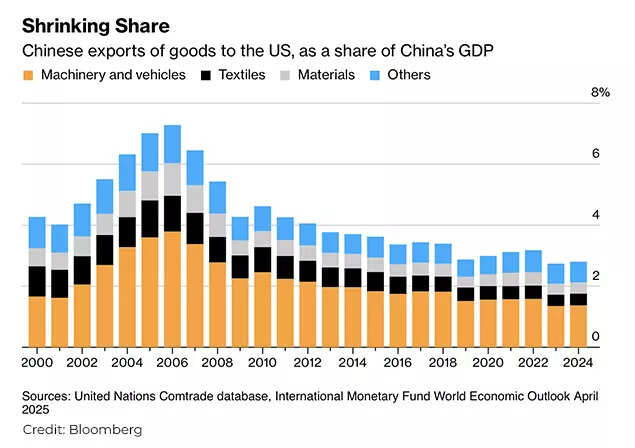
It’s certainly true that Trump’s policy pivot is a problem for Beijing. Bloomberg Economics calculations show tariffs at the current levels would erase more than 50% of sales to the US. But it’s far from the end of China’s development story. China’s exports to the US equal about 3% of gross domestic product—down from a peak of 7% two decades ago, after a campaign to diversify away from American consumers that’s been every bit as deliberate as US efforts to reduce reliance on Chinese supply chains. That means even if half of China’s exports to the US get wiped out, the blow to the overall economy is just 1.5%. Not good news, to be sure, but far from a disaster.
An article in Bloomberg
- Some of Trump’s policies have inadvertently strengthened Beijing’s position.
- Blanket “reciprocal” tariffs alienated allies such as India, a potential counterweight to China.
- Emerging markets in South America and Africa have moved closer to Beijing.
- China has overtaken the US as South America’s top trading partner.
- Trump’s tariff escalation and public insults have pushed India toward the BRICS bloc (China, Russia, Brazil).
- Shared grievances over US tariffs are fostering a possible Global South alignment that could reshape trade, energy, and security.
- Henry Wang (Center for China and Globalization, Beijing) says India–China ties are in an “up cycle.” Wang argues that as Global South leaders, India and China “have to really speak to each other.”
- The Economist rightly says that Beijing has mastered the dark arts of the trade war by shifting the battleground upstream. Rather than haggling over soybean buys or headline tariffs, Xi’s team is exploiting the places where China’s grip is tightest - rare earths, magnets, specialty metals, critical machine tools - to force concessions without making many.
- Whether Trump realizes it or not, Beijing is already winning the tempo war. Rare earths, minerals, and machine tools may not grab headlines like aircraft carriers, but in a world wired together by supply chains, they are weapons in their own right.
- The more Trump tries to squeeze China with tariffs, the more Beijing refines its ability to squeeze back - with more precision, less noise, and a longer view.
- Right now, Xi is betting that Trump will be the first to blink.

Advertising by Adpathway







;)