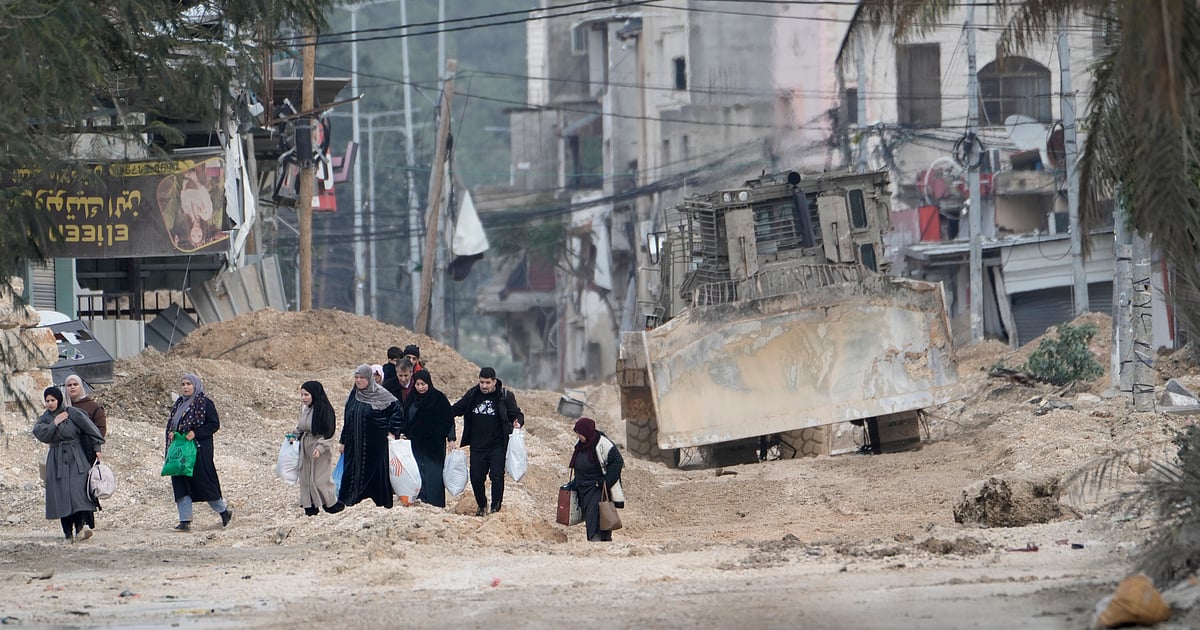
Israeli assault in West Bank triggers a wave of Palestinian displacement unseen in decades
Staying put
When the invasion started on Feb. 2, Israeli bulldozers ruptured underground pipes. Taps ran dry. Sewage gushed. Internet service was shut off. Schools closed. Food supplies dwindled. Explosions echoed.
Ahmad Sobuh could understand how his neighbors chose to flee the Far'a refugee camp during Israel's 10-day incursion. But he scavenged rainwater to drink and hunkered down in his home, swearing to himself, his family and the Israeli soldiers knocking at his door that he would stay.
The soldiers advised against that, informing Sobuh's family on Feb. 11 that, because a room had raised suspicion for containing security cameras and an object resembling a weapon, they would blow up the second floor.
The surveillance cameras, which Israeli soldiers argued could be exploited by Palestinian militants, were not unusual in the volatile neighborhood, Sobuh said, as families can observe street battles and Israeli army operations from inside.
But the second claim sent him clambering upstairs, where he found his nephew's water pipe, shaped like a rifle.
Hours later, the explosion left his nephew's room naked to the wind and shattered most others. It was too dangerous to stay.
"They are doing everything they can to push us out," he said of Israel's military, which, according to the U.N. agency for refugees, has demolished hundreds of homes across the four camps this year.
The Israeli army has described its ongoing campaign as a crucial counterterrorism effort to prevent attacks like Oct. 7, and said steps were taken to mitigate the impact on civilians.
A chilling return
The first thing Doha Abu Dgehish noticed about her family's five-story home 10 days after Israeli troops forced them to leave, she said, was the smell.
Venturing inside as Israeli troops withdrew from Far'a camp, she found rotten food and toilets piled with excrement. Pet parakeets had vanished from their cages. Pages of the Quran had been defaced with graphic drawings. Israeli forces had apparently used explosives to blow every door off its hinges, even though none had been locked.
Rama, her 11-year-old daughter with Down syndrome, screamed upon finding her doll's skirt torn and its face covered with more graphic drawings.
AP journalists visited the Abu Dgehish home on Feb. 12, hours after their return.
Nearly two dozen Palestinians interviewed across the four West Bank refugee camps this month described army units taking over civilian homes to use as a dormitories, storerooms or lookout points. The Abu Dgehish family accused Israeli soldiers of vandalizing their home, as did multiple families in Far'a.
The Israeli army blamed militants for embedding themselves in civilian infrastructure. Soldiers may be "required to operate from civilian homes for varying periods," it said, adding that the destruction of civilian property was a violation of the military's rules and does not conform to its values.
It said "any exceptional incidents that raise concerns regarding a deviation from these orders" are "thoroughly addressed," without elaborating.
For Abu Dgehish, the mess was emblematic of the emotional whiplash of return. No one knows when they'll have to flee again. "It's like they want us to feel that we're never safe," she said.
"That we have no control."

Advertising by Adpathway







;)