Author Correction: Endocytosis in the axon initial segment maintains neuronal polarity
Correction to: Nature https://doi.org/10.1038/s41586-022-05074-5 Published online 17 August 2022
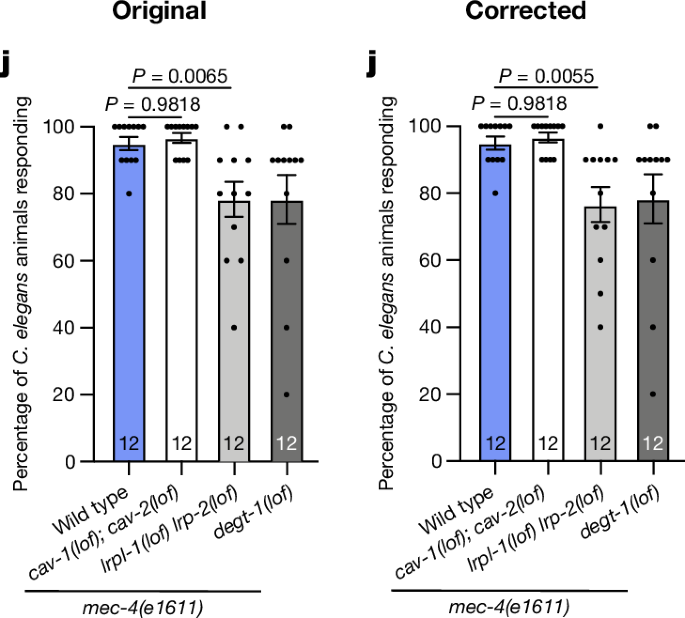
In the version of the article initially published, Fig. 3j and Extended Data Fig. 5a contained errors that were generated during figure assembly. In both cases, the initially published accompanying source data file contains the correct data. None of the paper’s interpretations are affected by this correction.
Figure 3j contained an error in the lrpl-1(lof) lrp2(lof) mutant data, which were mistakenly graphed and inadvertently duplicated from the overexpressed DMA-1 condition of Fig. 1p. This error only pertains to the lrpl-1(lof) lrp2(lof) mutant data. Data for wild type and degt-1(lof) were intentionally re-graphed between Fig. 1p and Fig. 3j as specified in the published Fig. 3 legend. The corrected graph is shown below in Fig. 1, together with the incorrect published graph, for transparency to the readers. This error did not affect any conclusions because the source data were correct, and the mistaken bar graph in question was from a mutant phenotype with a very similar defect (76.67% vs 78.33% of animals responding).

.
Extended Data Fig. 5a contained an incorrect display micrograph for the DMA-1(ΔYFGI) mutant. This error occurred during figure assembly, and the corresponding quantification and raw data for this experiment, which are graphed in Extended Data Fig. 5b, are correct. The corrected figure panel is shown below in Fig. 2, together with the incorrect published display panel, for transparency to the readers. This error did not affect any conclusions because the source data were correct, and the mistaken display panel was from a statistically indistinguishable genotype.

.
Author information
Authors and Affiliations
Corresponding author
Rights and permissions
Open Access This article is licensed under a Creative Commons Attribution 4.0 International License, which permits use, sharing, adaptation, distribution and reproduction in any medium or format, as long as you give appropriate credit to the original author(s) and the source, provide a link to the Creative Commons licence, and indicate if changes were made. The images or other third party material in this article are included in the article’s Creative Commons licence, unless indicated otherwise in a credit line to the material. If material is not included in the article’s Creative Commons licence and your intended use is not permitted by statutory regulation or exceeds the permitted use, you will need to obtain permission directly from the copyright holder. To view a copy of this licence, visit http://creativecommons.org/licenses/by/4.0/.
About this article

Cite this article
Eichel, K., Uenaka, T., Belapurkar, V. et al. Author Correction: Endocytosis in the axon initial segment maintains neuronal polarity. Nature (2025). https://doi.org/10.1038/s41586-025-08837-y
Published:
DOI: https://doi.org/10.1038/s41586-025-08837-y

Advertising by Adpathway







;)