Inclusive, Sustainable & Preserving Culture: How Amrit Bharat Stations Are Transforming Railways
Last Updated:
PM Modi will inaugurate 103 Amrit Stations spread across 86 districts and 18 states and UTs from Rajasthan's Bikaner on Wednesday

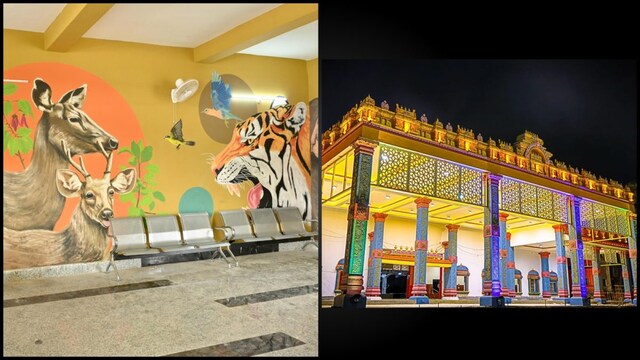
A view of the Haibargaon Amrit Station in Assam (left) and Sullurupeta Amrit Station in Andhra (right). (News18)
More than a means of transit and connectivity, railway stations in India have essentially been markers of growth. Yet, many, especially in smaller towns, have struggled to keep up with the pace of developing India. Recognising this, the Indian Railways launched the Amrit Bharat Station Scheme—an initiative to transform over 1,300 stations into modern, inclusive, and culturally resonant hubs.
A long-term plan for smart railway stations across India, the scheme took off in 2021 when the Gandhinagar Railway Station was redeveloped to feature contemporary design and state-of-the-art facilities, including a five-star hotel. A similar plan was used for Madhya Pradesh’s Rani Kamalapati Railway Station.
Recommended Stories
The feedback from these stations shows that passengers desire improved facilities. So, the railways came up with the Amrit Bharat Station Scheme to build stations of ‘Amrit Kaal’ Bharat.
Prime Minister Narendra Modi introduced the concept of Amrit Kaal during the 75th Independence Day celebrations in 2021. The 25-year period from 2022 to 2047– when the country will celebrate the centenary of its independence – is called the Amrit Kaal.
So, at a time when India will be more developed and will have a better quality of life, its stations should also be of the same level.
The Amrit Bharat Station Scheme is a step-by-step plan. While the Ministry of Railways has detailed plans for each station, the work is done in phases with prioritising what is needed first.
It was in February 2024 that the prime minister laid the foundation stone for redevelopment of 553 railway stations. In August 2023, he laid the foundation stone for the redevelopment of 508 stations.
On Wednesday, PM Modi will inaugurate 103 Amrit Stations across India from Rajasthan’s Bikaner. These Amrit Stations are spread across 86 districts in 18 states and Union Territories and are developed at a cost of over Rs 1,100 crore.
Indian Railways operates 13,000 trains daily, connecting 7,325 stations across the nation. The Railways has identified more than 1,300 stations for redevelopment so far.
Modernisation While Preserving Culture
While the stations across India will get some basic standard facilities, the Railways has ensured that the uniqueness of each station is maintained. The buildings of the stations are inspired by local culture, heritage and architecture.
So, while each station will have better passenger information systems, executive lounges, spaces for business meetings, and landscaping, keeping in view the necessity at each such station, they will also have some unique characteristics.
The Ahmedabad station in Gujarat is inspired from the Modhera Sun Temple and the one in Dwarka is inspired by the Dwarkadheesh Temple. The Gurugram Railway Station in Haryana will carry the IT theme, the Madurai station’s design reflects the grandeur of the Meenakshi Temple in Tamil Nadu and the Baleshwar station in Odisha is based on the Bhagwan Jagannath Temple. The design of the Udaipur Station in Rajasthan features a dome inspired by the Umaid Bhawan Palace.
Deshnoke railway station, from where the prime minister will inaugurate all the stations, is inspired by the architecture, arch and column theme from the Karni Mata Temple. The Begumpet railway station in Telangana is inspired by the architecture of the Kakatiya empire and the Thawe station in Bihar incorporates various murals and art works representing Maa Thawewali.
The stations that will be inaugurated by the prime minister include Mahe in Puducherry; Mandi Dabwali in Haryana; Baijnath Paprola in Himachal Pradesh; Sullurupeta in Andhra Pradesh and Haibargaon in Assam.
A total of eight stations are from Rajasthan—Fatehpur Shekhawati, Rajgarh, Govind Garh, Deshnoke, Gogameri, Mandawar Mahuwa Road, Bundi, and Mandal Garh. There are six stations from Madhya Pradesh—Shajapur, Narmadapuram, Katni South, Shridham, Seoni, and Orchha; nine from Tamil Nadu—Samalpatti, Tiruvannamalai, Chidambaram, Vriddhachalam, Mannargudi, Polur, Srirangam, Kulitturai, and St. Thomas Mount; and five from Chhattisgarh—Dongargarh, Bhanupratappur, Bhilai, Urkura, and Ambikapur.
Three stations each from Jharkhand—Sankarpur, Rajmahal, and Govindpur Road; West Bengal—Panagarh, Kalyani Ghoshpara, and Joychandi Pahar; and Telangana—Begumpet, Karimnagar, and Warangal—will also be inaugurated by the PM through video conference.
The highest number of stations is from Uttar Pradesh (19)—Bijnor, Saharanpur, Idgah Agra, Goverdhan, Fatehabad, Karchana, Govindpuri, Pokhrayan, Izzatnagar, Bareilly City, Hathras City, Ujhani, Siddharth Nagar, Swaminarayan Chappia, Mailani, Gola Gokaranath, Ramgath Halt, Suriampur, and Balrampur.
Next in line is Gujarat with 18 stations—Samakhiali, Morbi, Hapa, Jam Wanthali, Kanals, Okha, Mithapur, Rajula, Sihor, Palitana, Mahuva, Jam Jodhpur, Limbdi, Derol, Karamasad, Utran, Kosamba, and Dakor.
A total of 15 stations from Maharashtra will also be inaugurated—Parel, Chinchpokli, Vadala Road, Matunga, Shahad, Lonand, Kedgaon, Lasalgaon, Murtizapur, Devlali, Dhule, Savda, Chanda Fort, NSCB Itwari, and Amgaon.
The upgradation of these railway infrastructure and projects are critical for the future of India. Railway station redevelopment in India will allow these smaller towns to get an opportunity to welcome more business and tourists from bigger cities, opening the gates for a better and economically prosperous future.
Phased Implementation Strategy
Under the scheme, the detailed or master plan for each station will be implemented in phases to improve the amenities with no or minimum disruption in services to the passengers.
The focus is on improvement of station access, circulating and waiting areas apart from toilets, lift/escalators as per the need. In addition, there is and will be a strong focus on cleanliness. The railways has also made provisions for free Wi-Fi and kiosks for local products through schemes like ‘One Station One Product’ (OSOP).
The Amrit Stations will have an improved building and will connect with both sides of the city. They will offer multimodal integration as well, connecting metros, local buses and other modes of transportation at one point. The focus is also on amenities for Divyangjans while keeping the infrastructure sustainable and environment friendly. Each station, based on the need, will have ‘Roof Plazas’ and creation of city centres at the station in the long term.
Once fully developed, these stations will become more than transit points. They will be welcome gateways that celebrate regional identity while serving the needs of every traveller. As India advances through its Amrit Kaal, these transformed stations will stand as enduring symbols of a nation that honours its past, embraces the present, and moves confidently towards a brighter and inclusive future, opening up windows for economic growth.
- First Published:
May 21, 2025, 09:34 IST

Advertising by Adpathway







;)