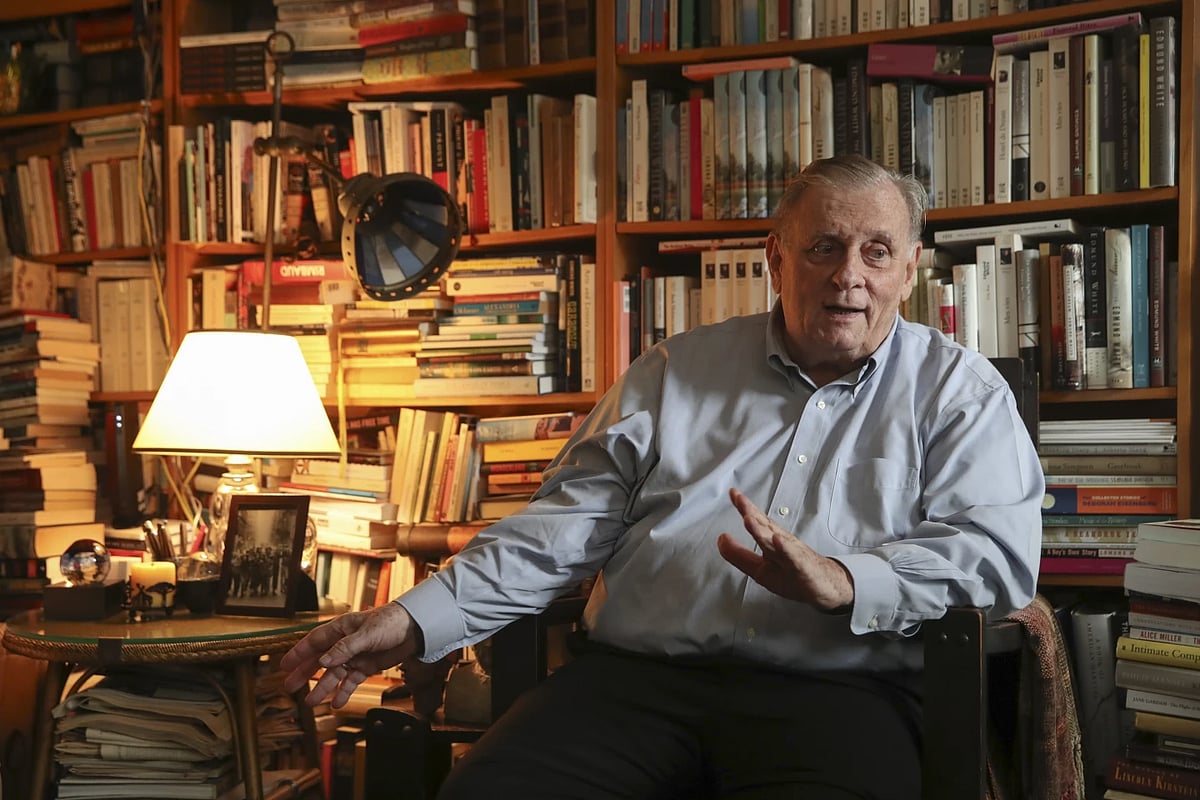
Edmund White, groundbreaking gay author, dies at 85
Early struggles, changing times
Through much of the 1960s, he was writing novels that were rejected or never finished. Late at night, he would “dress as a hippie, and head out for the bars.” A favorite stop was the Stonewall, where he would down vodka tonics and try to find the nerve to ask a man he had crush on to dance. He was in the neighborhood on the night of June 28, 1969, when police raided the Stonewall and “all hell broke loose.”
“Up until that moment we had all thought homosexuality was a medical term,” wrote White, who soon joined the protests. “Suddenly we saw that we could be a minority group — with rights, a culture, an agenda.”
Before the 1970s, few novels about openly gay characters existed beyond Vidal’s “The City and the Pillar” and James Baldwin’s “Giovanni’s Room.” Classics such as William Burroughs’ “Naked Lunch” had “rendered gay life as exotic, marginal, even monstrous,” according to White. But the world was changing, and publishing was catching up, releasing fiction by White, Kramer, Andrew Holleran and others.
White’s debut novel, the surreal and suggestive “Forgetting Elena,” was published in 1973. He collaborated with Charles Silverstein on “The Joy of Gay Sex,” a follow-up to the bestselling “The Joy of Sex” that was updated after the emergence of AIDS. In 1978, his first openly gay novel, “Nocturnes for the King of Naples,” was released and he followed with the nonfiction “States of Desire,” his attempt to show “the varieties of gay experience and also to suggest the enormous range of gay life to straight and gay people — to show that gays aren’t just hairdressers, they’re also petroleum engineers and ranchers and short-order cooks.”
With “A Boy’s Own Story,” published in 1982, he began an autobiographical trilogy that continued with “The Beautiful Room is Empty” and “The Farewell Symphony,” some of the most sexually direct and explicit fiction to land on literary shelves. Heterosexuals, he wrote in “The Farewell Symphony,” could “afford elusiveness.” But gays, “easily spooked,” could not “risk feigning rejection.”
His other works included “Skinned Alive: Stories” and the novel “A Previous Life,” in which he turns himself into a fictional character and imagines himself long forgotten after his death. In 2009, he published “City Boy,” a memoir of New York in the 1960s and ‘70s in which he told of his friendships and rivalries and gave the real names of fictional characters from his earlier novels. Other recent books included the novels “Jack Holmes & His Friend” and “Our Young Man” and the memoir “Inside a Pearl: My Years in Paris.”
“From an early age I had the idea that writing was truth-telling,” he told The Guardian around the time “Jack Holmes” was released. “It’s on the record. Everybody can see it. Maybe it goes back to the sacred origins of literature — the holy book. There’s nothing holy about it for me, but it should be serious and it should be totally transparent.”

Advertising by Adpathway






;)