“We have completed our very successful attack on the three Nuclear sites in Iran.”

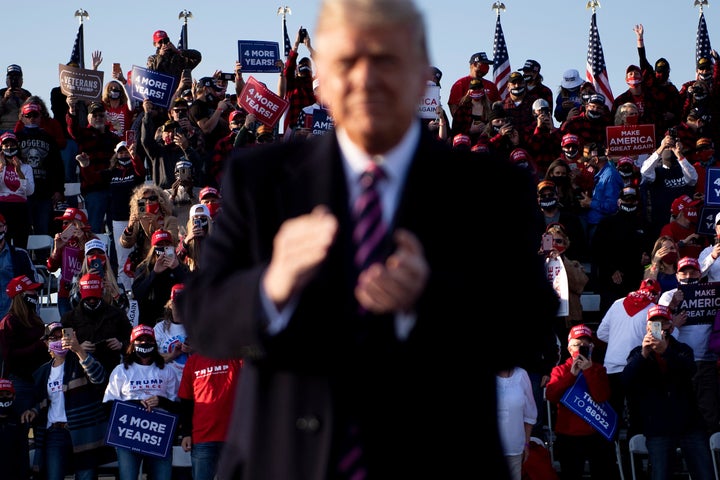
President Donald Trump said Saturday the United States bombed three Iranian nuclear sites, bringing the U.S. directly into Israel’s war with Tehran.
“We have completed our very successful attack on the three Nuclear sites in Iran, including Fordow, Natanz, and Esfahan,” Trump said in a post on Truth Social on Saturday.
It was not immediately clear what damage the strikes caused or how significant a blow was dealt to Tehran’s program. It could take some time before the results are clear. Trump said the U.S. used “a full payload of BOMBS … on the primary site, Fordow,” which is also known as Fordo.
The strikes mark the most significant U.S. military attack on Iran in modern history and will have a defining impact on the legacy of Trump’s second term in office.
Trump said all planes are “safely on their way home,” and out of Iranian airspace. Trump had said Thursday he would take two weeks to decide whether to bomb Iran’s nuclear sites to give diplomacy a chance.
“NOW IS THE TIME FOR PEACE!,” he said in the statement.
Trump’s decision to directly involve the U.S. military was the culmination of weeks of mixed signals from the GOP president who campaigned on a promise of ending wars started by his predecessors and pledged to resist overseas military involvement. It is likely to exacerbate a fierce debate within the Republican Party about what his “America First” doctrine means and risks alienating meaningful parts of Trump’s base.
The U.S has surged forces to the region over the past two weeks, including new squadrons of F-16, F-22 and F-35 fighter planes, and the deployment of several destroyers to the Israeli coast. A second aircraft carrier, the USS Carl Vinson, is on its way to the Arabian Sea along with its own destroyer escorts and should arrive in the coming days, while a third carrier could soon be on the way, as the USS Ford is slated to leave port in Virginia in the coming days for a planned European deployment.
One U.S. defense official said that there has been some concern in the Pentagon that significant open-ended deployments could bog down forces in the region and impact their readiness if they were kept there for an extended period of time. They added these worries weren’t a reason for launching the strikes, but some military officials suggested a relatively quick decision on any possible strike in order to avoid keeping forces tied down with no clear mission.
Two other U.S. defense officials said it was too soon for a battle damage assessment in the immediate aftermath of the strikes but the Pentagon was immediately turning its attention to protecting American troops still in the region as the Trump administration was guessing at Iran’s next steps.
There are about 40,000 U.S. troops in the region, with 2.500 in Iraq next door to Iran.
The Fordo nuclear enrichment facility is buried deep inside a mountain to shield it from attacks.
Israel has been lobbying the U.S. to get involved in the military effort against Iran’s nuclear program for months, stepping up the effort after it launched unilateral strikes on Iran’s nuclear sites earlier this month.
Only the U.S. possesses the 30,000-pound bombs capable of reaching the deep underground site at Fordo, and those can be carried only by American B-2 stealth bombers because they are so heavy. It was not immediately clear if the strikes were successful or what weapons or aircraft the U.S. used. Earlier Saturday, the U.S. moved B-2s toward Guam in the Pacific Ocean, which some analysts saw as a sign the U.S. was preparing to strike Fordo.
Jonathan Panikoff, a former senior intelligence official who is now at the Atlantic Council, said whether Iran decides to respond proportionally or not could “quickly lead to an escalatory spiral.”
“One has to wonder if Iran missed its opportunity in its seeming unwillingness or lack of desire to engage diplomatically. Now Iran’s reaction will drive how much further this goes,” he said.
With no diplomatic cards left to play, experts said Trump resorted to the military option that was still left.
“Last-chance European diplomacy failed. This wasn’t deception by Trump,” said Bilal Saab, who served in the Pentagon during the first Trump administration. “Now we wait and ideally have planned for Iranian retaliation.”
Iran’s reaction, “all depends on what Khamenei decides to do now,” he said, referring to Iran’s supreme leader. “Back down or fight probably until the end. We have signaled to the Iranians this is the extent of the attack but Iran gets a vote on what happens next.”
Jon Hoffman, a research fellow at the libertarian Cato Institute which has been against American involvement, said U.S. participation will only bring “disaster.”
“War with Iran is not America first – it is America last,” he said, adding that Israel’s initial strikes on Iran’s nuclear facilities were “always a smokescreen designed to drag the U.S. into war as an active participant.”
Nahal Toosi and Amy Mackinnon contributed to this report








;)