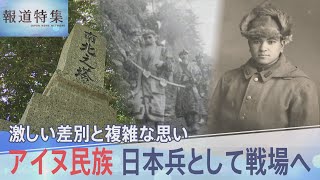
Ainu Soldiers in WWII: Struggling with Discrimination
HOKKAIDO, Aug 11 (News On Japan) - The Ainu, an indigenous group native to Hokkaido and other areas, were conscripted to serve as Japanese soldiers during WWII. Despite enduring severe discrimination, their complex feelings toward this reality are still felt today.
In May of this year, during the Osaka Kansai Expo, a performance by the Ainu people was showcased. The theme of the performance, “Ureshimo Shiri,” meaning "the earth we live on together," was explained by the general director, Akibe Debo, from the Ainu community in Hokkaido. He described it as a celebration of how nature, from the mountains and wind to lakes and waves, all supports life. He emphasized that this philosophy underlines that war should not exist, highlighting the importance of peace.
However, the history of the Ainu has been inextricably linked with war and discrimination. The Meiji government confiscated Ainu lands, banned activities such as hunting and fishing, and enforced policies that led to their cultural erosion. Under the guise of protection, the government allocated them poor land, pushing for a policy of assimilation. The Ainu endured systemic racism and lost much of their cultural heritage.
In Hokkaido’s Minami-Awaji City, where Ainu traditions are still evident, many Ainu people recall personal experiences of discrimination. For instance, Keita Hamada, a man from the area, recalled how, over 50 years ago, he was ordered by his teacher to shave his hair. “I didn’t want to do it, but as a fifth grader, I had no choice,” he reflected. The discrimination was not just limited to teachers; it was pervasive throughout his community, even when he excelled academically.
The Ainu’s struggle didn’t end at home; they were sent to the frontlines during WWII. One such conscript, a 20-year-old Ainu soldier, was dispatched to Manchuria. Upon his return, he shared his painful experiences of being publicly humiliated by his comrades due to his ethnicity. He was called derogatory names, and mocked for his roots.
Similar stories can be found among Ainu soldiers. In 1994, an interview with an Ainu man who had been stationed at a former battleground in Chitose revealed the intense discrimination he faced from his superiors. He recalled being treated violently, simply for being Ainu.
This harsh treatment extended to other ethnic minorities in the Japanese military. The Ainu, along with groups such as the Uilta from Sakhalin, were exploited for their physical abilities and knowledge, often sent to carry out dangerous tasks or spy missions.
Despite this, the Ainu soldier, Hamada, managed to earn recognition in the military for his achievements. He worked diligently and proved himself, rising from a private to a sergeant. “We fought to gain respect, to show that we could accomplish something despite the prejudices,” he said.
However, the Ainu's participation in the war did not result in the equality they hoped for. According to Mark Ince, a researcher at the National Museum of Ethnology, many Ainu soldiers sought equality through their service, but the harsh realities of colonization and historical oppression overshadowed their ambitions.
The role of the Ainu in WWII is also memorialized in Okinawa. Despite being far from their homeland in Hokkaido, many Ainu soldiers fought and died in the Battle of Okinawa. Of the 20,000 soldiers who perished in the battle, around 1,000 were from Hokkaido. In 1966, a memorial called the “Northern Tower” was erected in Okinawa to honor the fallen, including Ainu soldiers.
In recent years, efforts have been made to revive Ainu traditions in Okinawa, including the performance of the Icharupa ceremony, which had ceased for 20 years. On June 23, 2025, during the 80th anniversary of the Battle of Okinawa, Ainu representatives and Okinawan locals together performed the Icharupa ceremony at the Northern Tower, a poignant moment in the long history of Ainu contributions to the war effort and their quest for peace.
The historical events surrounding the Ainu's involvement in WWII are largely forgotten, and in modern times, their identity is often denied or marginalized. This was highlighted by recent hate comments on social media that claimed the Ainu no longer exist. Additionally, some politicians have attempted to rewrite history, particularly regarding Okinawa’s wartime experience, which includes the Ainu soldiers' sacrifices.
Source: TBS

Advertising by Adpathway






;)