Underdeck park under I-395 may arrive piecemeal
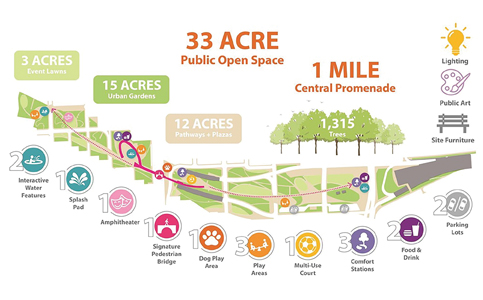
Miami is searching for alternative funding sources for the Underdeck after the Trump administration rescinded a $60.3 million federal grant that was supposed to fund most of the 33-acre linear park.
Earlier this month, the US Department of Transportation informed city officials that the award, the largest in Miami’s history, was canceled under the administration’s recently passed “One Big Beautiful Bill Act.” Now, the city says it is searching for other funding to keep the project alive, even if that means extending the original 2026 completion date.
Commissioner Christine King, who represents Overtown where much of the Underdeck is planned, said she is “disappointed, but not discouraged” by the decision. She pledged to work with stakeholders and private partners to ensure the project moves forward.
Part of a much larger $866 million overhaul of downtown Miami’s highway infrastructure which includes construction of the new I-395 Signature Bridge, the Underdeck is envisioned as a mile-long path weaving beneath the elevated I-395 viaducts, transforming the concrete expanse with 33-acres of active public green space and reconnecting Overtown, a historically Black neighborhood divided by highway construction in the 1960s, with downtown and Biscayne Bay.
While known as the Underdeck, the Miami City Commission voted last year to officially name the park the Rev. Edward T. Graham Heritage Trail in honor of the late civil rights activist who was pastor at Mt. Zion Baptist Church in Overtown for more than three decades.
The trail’s plans include an amphitheater, event lawn, dog park, community plaza, playgrounds, multi-use courts and water features, all designed to support recreation, cultural events and community gatherings.
The $60.3 million grant was announced in March 2024 under the Biden administration’s Neighborhood Access and Equity program, which sought to redress harms caused by past transportation projects. At the time, Miami Mayor Francis Suarez said it was the largest federal award the city had ever received.
With money now rescinded that covered nearly three-quarters of the project’s $82.7 million price tag, Miami faces a major funding gap. The city has already invested 80% of the project’s cost for the portion that falls within its boundaries, and officials are now weighing options, including public-private partnerships and potentially reapplying for federal funds in future cycles.
“We have a strong track record of impactful public-private partnerships coming together for the benefit of our community, especially in times of great need,” Ms. King said, adding that the loss of $60 million qualifies as one of those moments.
She continued, “As we work with our city partners and supporters to raise funds for the maintenance and continuation of these once-ignored spaces, now transforming into active, beloved trails, I have not given up hope that we might secure the grant again in a future funding cycle.”
“If we must develop the pathway incrementally, that is what we will do, little by little,” she said. “Giving up is not an option. The obstacle is the way.”

Advertising by Adpathway






;)