El Mayo Zambada demands repatriation to Mexico: Friday’s mañanera recapped
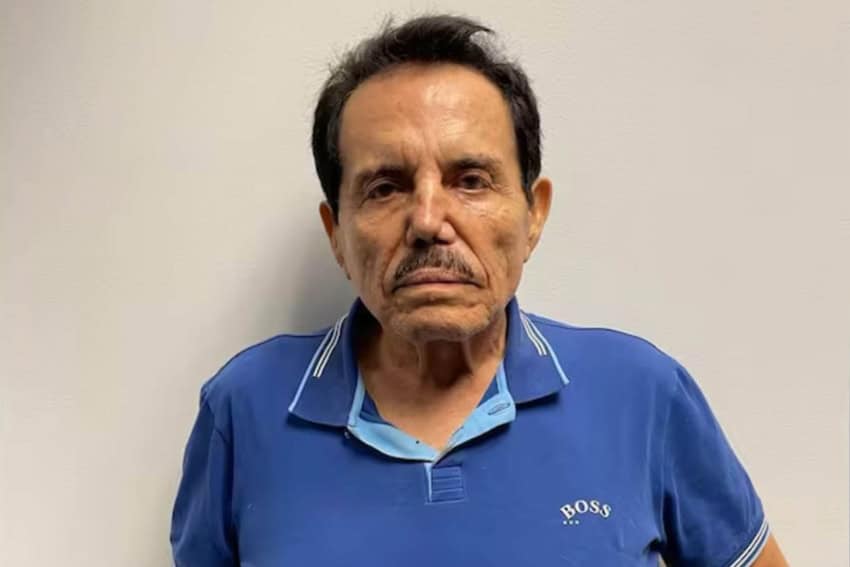
A letter to the federal government from accused drug baron Ismael “El Mayo” Zambada and the fight against organized crime were among the issues President Claudia Sheinbaum spoke about at her Friday morning press conference.
Here is a recap of the president’s last mañanera of the week.
El Mayo demands repatriation; FGR reviewing the request
A reporter from the Reforma newspaper noted that a legal advisor of Ismael “El Mayo” Zambada submitted a letter to the Mexican Consulate in New York in which the alleged Sinaloa Cartel leader demands that the Mexican government “immediately” request his repatriation.
Zambada was arrested at an airport in New Mexico last July after flying into the United States on a private plane with Joaquín Guzmán López, one of the sons of imprisoned drug lord Joaquín “El Chapo” Guzmán. El Mayo, who is currently in custody in New York, claims he was kidnapped by Guzmán López and forced onto the plane.
On Friday morning, Sheinbaum confirmed that the Mexican Consulate in New York received Zambada’s request for repatriation.
She said that the Federal Attorney General’s Office (FGR) has an open file on the alleged drug trafficker’s arrest and that her administration and the independent FGR would review his request.
“Beyond the person that is making the request” and “his crimes,” the issue at stake is the way in which his arrest occurred, said Sheinbaum. The president has accused the United States government of involvement in a plot to kidnap Zambada.
“The attorney general [Alejandro Gertz Manero] already has an open file in this sense,” she said.
“If you like on Tuesday, the day of the [government] security report, he can tell us what progress has been made, what information has been requested from the United States government and what comes next in this case,” Sheinbaum said.
Asked whether the Mexican government would file “a formal protest due to the violation of the treaty that prevents cross-border kidnappings,” the president said her administration would look into that possibility.
“I repeat, beyond this person and the crimes he has committed, the issue is the rights of a Mexican citizen facing trial there [in the United States],” Sheinbaum said.
“… Let’s suppose that it was another person. … Any citizen who is wanted in the United States and is taken to the United States without any participation of the Mexican government. … Let’s suppose it’s a renowned citizen, whoever it may be … he’s taken there [against his will] and put on trial facing the death penalty,” she said.
“So there is an issue in [Zambada’s] letter … that has to do with sovereignty,” said Sheinbaum, who on Thursday responded to the United States’ designation of six Mexican cartels as foreign terrorist organizations by announcing she was sending a constitutional reform proposal to Congress to bolster the protection of Mexico’s sovereignty.
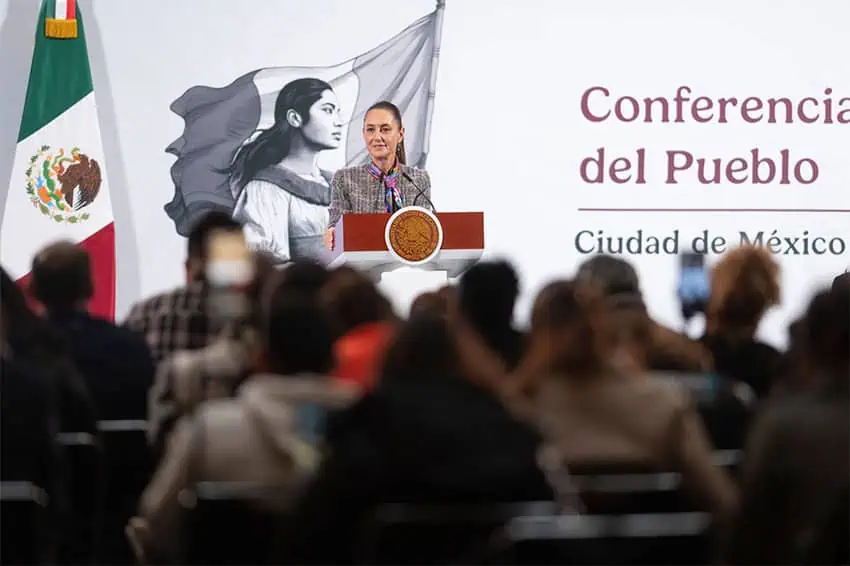
“… The Attorney General’s Office has worked on this issue a lot and we’re going to review [the repatriation request] with the attorney general,” she said.
In his letter — which was seen by Reforma — Zambada said that the Mexican government must “immediately” request his repatriation because his transfer to the United States was “illegal.”
“… Any legal process against me must be carried out in Mexico in accordance with national laws and current international agreements,” he wrote.
Zambada said that the Mexican government “must intervene so that the present matter doesn’t result in a collapse of the bilateral relation.”
“… The irregular and illegal way in which the undersigned was placed at the disposal of the United States authorities should not be overlooked,” he wrote.
Zambada, who faces drug trafficking, money laundering and weapons charges, asserted that “the United States lacks legitimacy to impose on me a punishment as serious as the death penalty.”

“… The United States failed to fulfill its obligation to verify the legality of my entry,” he wrote.
“… The Mexican state has the obligation to intervene and demand formal guarantees that the death penalty won’t be enforced on me,” Zambada said.
“… If the government of Mexico doesn’t act, the undersigned will be sentenced to the death penalty without any doubt and this will constitute a dangerous precedent that would allow any foreign government at any time to violate our territory and sovereignty with impunity, intervening for the arrest of any person, even politicians or government officials, in order to transfer them to the United States jurisdiction,” he wrote.
“… I demand that the Mexican state comply with its inescapable obligation to immediately and forcefully intervene … to formally demand of the United States absolute, full, binding and irrevocable guarantees and certainty that the death penalty won’t be enforced on me in their jurisdiction. This demand is not optional,” Zambada said.
Asked whether Zambada’s case could cause the Mexico-U.S. relationship to “collapse” — as El Mayo claimed it could — Sheinbaum said “that is another issue” and “I don’t believe so.”
Sheinbaum responds to US Embassy’s recognition of Mexico’s ‘blows against organized crime!’
A reporter noted that the United States Embassy in Mexico congratulated the federal government for its recent “blows against organized crime,” among which are the arrests of two key operatives of the Sinaloa Cartel in Culiacán this week.
The U.S. Embassy shared an X post by federal security minister Omar García Harfuch announcing the arrest of one of those operatives, Kevin Alonso Gil Acosta, aka El “200.”

Advertising by Adpathway







;)