The Russia-Ukraine War: Three Years On
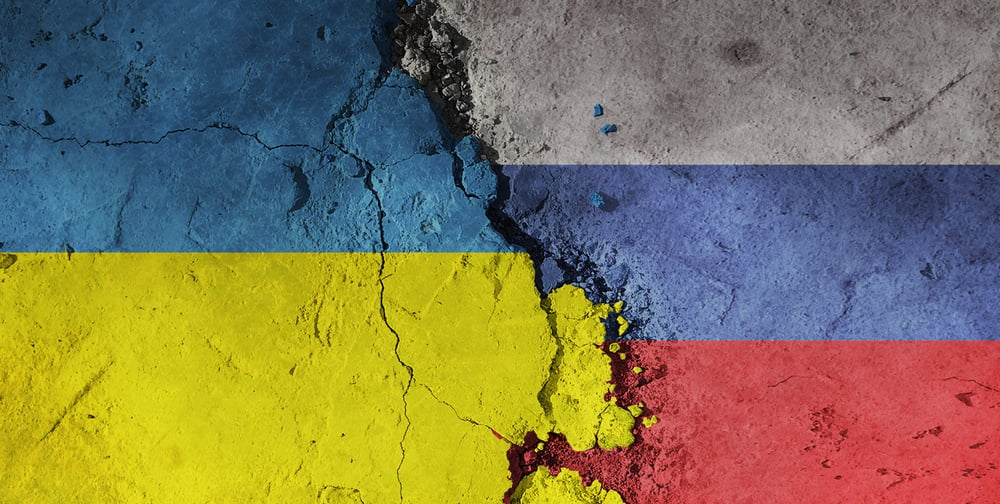
Russia and Ukraine have been in a state of full-scale war for three years. The number of killed and injured soldiers, on each side, is now measured in the hundreds of thousands. Eastern Ukraine, the former industrial heartland of the country, now stands in ruins. Stretching for over 1000 kilometers, the front line is barely moving, while an aggressive mobilization campaign in the civilian sector ensures a steady flow of new recruits to reinforce this stalemate of mass slaughter.
What is the point of continuing to push the toiling people of these nations that, just over a generation ago, shared one country, the Soviet Union, to kill each other on an industrial scale?
In Ukraine, the answer to this question is obvious, at least among the leading agents of the ruling class. “To win or not to be. This is not a question; it is a terrible, brutal dilemma for Ukraine, for Europe, for the entire civilized world,” declared Victor Pinchuk, the country’s second richest man, at the elite gathering of the 2024 Yalta European Strategy conference. He called on the West to provide more assistance, describing it as a win-win partnership, in which “the West doesn’t give lives; only Ukrainians do.”
The willingness of the Ukrainians to give up their lives is guaranteed by a campaign of forced mobilization, which has been ongoing since the start of the full-scale war. Across the country, from large cities to small towns and villages, the conscription of new recruits is administered by the so-called Territorial Center of Recruitment and Social Support. The main target of their daily raids are men within the age group 25 to 50, namely, those with the lowest income and no capacity to bribe themselves out. Once mobilized, these men face indefinite service in the military, with a maximum monthly compensation of 100,000 hryvnias – about $2500 – for being deployed on the front line. The majority of Ukrainians view this as a one-way ticket to the grave and desperately try to avoid mobilization.
Those who fail to escape mobilization get the opportunity to sacrifice themselves by “dying for the cause of independence,” which Pinchuk defined as the condition where “the country is… anchored in the West, its natural geographic, political, and strategic home.” Incidentally, the West has long been the strategic export market and investment destination for Pinchuk’s business empire. While the war is destroying Ukraine’s infrastructure, the Interpipe Group, a company specializing in the manufacturing of steel pipes and railway products, is boasting that 83 percent of its output is intended for export, with the European market accounting for 47 percent of the sales. Pinchuk and his family retain a large real estate portfolio, including the Grand Buildings in London and four villas on the Italian island of Sardinia.
Besides Pinchuk, this cause of independence is also entirely compatible with the business schemes of Ukraine’s wealthiest capitalist, Rinat Akhmetov, and his mining and steel conglomerate Metinvest. The company’s CEO, Yuriy Ryzhenkov, proudly boasts that Metinvest is successfully able to export raw materials out of the war-turn country, while channeling the proceeds into the development of its enterprises in the European Union. Among its current goals, reports Ryzhenkov, is the acquisition of the Polish steel plate producer Liberty Czestochowa, which would provide “a good opportunity for Metinvest to go into European green steel production…”
Metinvest is also working on expanding its production activities in Italy, where the company already owns two plate mills in the north of the country. The latest edition is a joint venture project with the European steel manufacturer Danieli in the coastal town of Piombino, with construction set to begin in the first quarter of 2025. According to Ryzhenkov, the plant would “use iron ore from Ukraine to produce [finished] steel in Italy.” In the current conditions, claims the CEO, “it’s natural” for Ukraine’s largest corporation “to build… somewhere on the Mediterranean,” no less so than for its owner to hold his wealth in the form of luxury real estate, stretching across Britain, France, Belgium and Switzerland.
It is no accident that Akhmetov and Pinchuk now rank at the top of Ukraine’s financial elite. Such is the reward for not following the path of their counterparts who backed the ousted Ukrainian president Victor Yanukovych in 2014 and thus became the target of Western sanctions and had to leave the country and relocate to Russia. Such is the reward for keeping Ukraine in the pro-Western camp and backing Zelensky’s government in the face of the full-scale war with Russia.
The Ukrainian capitalists benefit from the status quo where the country’s working class is being sacrificed at the front. So does the Russian bourgeoisie, for whom Ukraine is simply a buffer state in the struggle against Western competitors.
In an interview with RBK, Vladimir Potanin, the largest shareholder of the mining giant Nornickel, lectured the public on the importance of resilience.
“We, as a… country, must [stay] in good shape and simply survive this period and reach the shore on which we will then build new rules of relations with all other countries…”
Surviving this period is no big deal for Potanin, who was happy to report that, “in my case, I think it was easy to adjust” to the new conditions. In response to Western sanctions, Nornickel simply shifted “the logistics chain to more friendly countries, particularly to China…” Sharing a similar view, another leading Russian capitalist, Alisher Usmanov, whose net worth currently stands at $15 billion, proudly declared that Western sanctions failed “to punish the business elite…” The West “wanted to harm the Russian economy, but it is growing.”
Read More – The Russia-Ukraine War: Three Years On

Advertising by Adpathway





;)