Superconductivity and quantized anomalous Hall effect in rhombohedral graphene
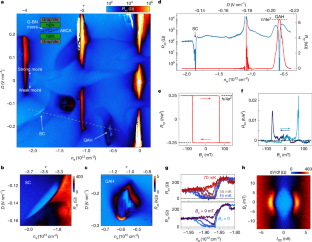
Inducing superconducting correlations in chiral edge states is predicted to generate topologically protected zero energy modes with exotic quantum statistics1,2,3,4,5,6. Experimental efforts so far have focused on engineering interfaces between superconducting materials—typically amorphous metals—and semiconducting quantum Hall7,8,9,10,11 or quantum anomalous Hall12,13 systems. However, the strong interfacial disorder inherent in this approach can prevent the formation of isolated topological modes14,15,16,17. An appealing alternative is to use low-density flat band materials in which the ground state can be tuned between intrinsic superconducting and quantum anomalous Hall states using only the electric field effect. However, quantized transport and superconductivity have not been simultaneously achieved. Here we show that rhombohedral tetralayer graphene aligned to a hexagonal boron nitride substrate hosts a quantized anomalous Hall state at superlattice filling ν = −1 as well as a superconducting state at ν ≈ −3.5 at zero magnetic field. Gate voltage can also be used to actuate non-volatile switching of the chirality in the quantum anomalous Hall state18, allowing, in principle, arbitrarily reconfigurable networks of topological edge modes in locally gated devices. Thermodynamic compressibility measurements further show a topologically ordered fractional Chern insulator at ν = 2/3 (ref. 19)—also stable at zero magnetic field—enabling proximity coupling between superconductivity and fractionally charged edge modes. Finally, we show that, as in rhombohedral bi- and trilayers20,21,22, integrating a transition metal dichalcogenide layer to the heterostructure nucleates a new superconducting pocket20,21,22,23,24, while leaving the topology of the ν = −1 quantum anomalous Hall state intact. Our results pave the way for a new generation of hybrid interfaces between superconductors and topological edge states in the low disorder limit.Abstract
This is a preview of subscription content, access via your institution
Access options
Access Nature and 54 other Nature Portfolio journals
Get Nature+, our best-value online-access subscription
$29.99 / 30 days
cancel any time
Subscribe to this journal
Receive 51 print issues and online access
$199.00 per year
only $3.90 per issue
Buy this article
- Purchase on SpringerLink
- Instant access to full article PDF
Prices may be subject to local taxes which are calculated during checkout


Data availability
Data are available at Zenodo (https://doi.org/10.5281/zenodo.14458163)55.
References
Qi, X.-L., Hughes, T. L. & Zhang, S.-C. Chiral topological superconductor from the quantum Hall state. Phys. Rev. B 82, 184516 (2010).
Clarke, D. J., Alicea, J. & Shtengel, K. Exotic non-Abelian anyons from conventional fractional quantum Hall states. Nat. Commun. 4, 1348 (2013).
Clarke, D. J., Alicea, J. & Shtengel, K. Exotic circuit elements from zero-modes in hybrid superconductor-quantum-Hall systems. Nat. Phys. 10, 877–882 (2014).
Mong, R. S. K. et al. Universal topological quantum computation from a superconductor-Abelian quantum Hall heterostructure. Phys. Rev. X 4, 011036 (2014).
Lian, B., Sun, X.-Q., Vaezi, A., Qi, X.-L. & Zhang, S.-C. Topological quantum computation based on chiral Majorana fermions. Proc. Natl Acad. Sci. USA 115, 10938–10942 (2018).
Lindner, N. H., Berg, E., Refael, G. & Stern, A. Fractionalizing Majorana fermions: non-Abelian statistics on the edges of Abelian quantum Hall states. Phys. Rev. X 2, 041002 (2012).
Lee, G.-H. et al. Inducing superconducting correlation in quantum Hall edge states. Nat. Phys. 13, 693–698 (2017).
Amet, F. et al. Supercurrent in the quantum Hall regime. Science 352, 966–969 (2016).
Vignaud, H. et al. Evidence for chiral supercurrent in quantum Hall Josephson junctions. Nature 624, 545–550 (2023).
Gul, O. et al. Andreev reflection in the fractional quantum Hall state. Phys. Rev. X 12, 021057 (2022).
Barrier, J. et al. One-dimensional proximity superconductivity in the quantum Hall regime. Nature 628, 741–745 (2024).
Uday, A. et al. Induced superconducting correlations in a quantum anomalous Hall insulator. Nat. Phys. 20, 1589–1595 (2024).
Atanov, O. et al. Proximity-induced quasi-one-dimensional superconducting quantum anomalous Hall state. Cell Rep. Phys. Sci. 5, 101762 (2024).
Tang, Y., Knapp, C. & Alicea, J. Vortex-enabled Andreev processes in quantum Hall–superconductor hybrids. Phys. Rev. B 106, 245411 (2022).
Kurilovich, V. D., Raines, Z. M. & Glazman, L. I. Disorder-enabled Andreev reflection of a quantum Hall edge. Nat. Commun. 14, 2237 (2023).
Kurilovich, V. D. & Glazman, L. I. Criticality in the crossed Andreev reflection of a quantum Hall edge. Phys. Rev. X 13, 031027 (2023).
Ji, W. & Wen, X.-G. \(\frac{1}{2}({e}^{2}/h)\) Conductance plateau without 1D chiral majorana fermions. Phys. Rev. Lett. 120, 107002 (2018).
Polshyn, H. et al. Electrical switching of magnetic order in an orbital Chern insulator. Nature 588, 66–70 (2020).
Lu, Z. et al. Fractional quantum anomalous Hall effect in multilayer graphene. Nature 626, 759–764 (2024).
Zhang, Y. et al. Enhanced superconductivity in spin-orbit proximitized bilayer graphene. Nature 613, 268–273 (2023).
Patterson, C. L. et al. Superconductivity and spin canting in spin-orbit proximitized rhombohedral trilayer graphene. Preprint at http://arxiv.org/abs/2408.10190 (2024).
Yang, J. et al. Diverse impacts of spin-orbit coupling on superconductivity in rhombohedral graphene. Preprint at http://arxiv.org/abs/2408.09906 (2024).
Holleis, L. et al. Nematicity and orbital depairing in superconducting Bernal bilayer graphene. Nat. Phys. https://doi.org/10.1038/s41567-024-02776-7 (2025).
Li, C. et al. Tunable superconductivity in electron- and hole-doped Bernal bilayer graphene. Nature 631, 300–306 (2024).
Klitzing, K. V., Dorda, G. & Pepper, M. New method for high-accuracy determination of the fine-structure constant based on quantized Hall resistance. Phys. Rev. Lett. 45, 494–497 (1980).
Stepanov, P. et al. Competing zero-field Chern insulators in superconducting twisted bilayer graphene. Phys. Rev. Lett. 127, 197701 (2021).
Foutty, B. A. et al. Mapping twist-tuned multiband topology in bilayer WSe2. Science 384, 343–347 (2024).
Xia, Y. et al. Superconductivity in twisted bilayer WSe2. Nature 637, 833–838 (2025).
Guo, Y. et al. Superconductivity in 5.0° twisted bilayer WSe2. Nature 637, 839–845 (2025).
Li, T. et al. Quantum anomalous Hall effect from intertwined moiré bands. Nature 600, 641–646 (2021).
Park, H. et al. Observation of fractionally quantized anomalous Hall effect. Nature 622, 74–79 (2023).
Zhou, H. et al. Half- and quarter-metals in rhombohedral trilayer graphene. Nature 598, 429–433 (2021).
Zhou, H., Xie, T., Taniguchi, T., Watanabe, K. & Young, A. F. Superconductivity in rhombohedral trilayer graphene. Nature 598, 434–438 (2021).
Zhou, H. et al. Isospin magnetism and spin-polarized superconductivity in Bernal bilayer graphene. Science 375, 774–778 (2022).
Chen, G. et al. Tunable correlated Chern insulator and ferromagnetism in a moiré superlattice. Nature 579, 56–61 (2020).
Chen, G. et al. Signatures of tunable superconductivity in a trilayer graphene moiré superlattice. Nature 572, 215–219 (2019).
Xie, J. et al. Even- and odd-denominator fractional quantum anomalous Hall effect in graphene moire superlattices. Preprint at http://arxiv.org/abs/2405.16944 (2024).
Chen, G. et al. Evidence of a gate-tunable Mott insulator in a trilayer graphene moiré superlattice. Nat. Phys. 15, 237 (2019).
Zhang, F., Jung, J., Fiete, G. A., Niu, Q. & MacDonald, A. H. Spontaneous quantum hall states in chirally stacked few-layer graphene systems. Phys. Rev. Lett. 106, 156801 (2011).
Park, Y., Kim, Y., Chittari, B. L. & Jung, J. Topological flat bands in rhombohedral tetralayer and multilayer graphene on hexagonal boron nitride moiré superlattices. Phys. Rev. B 108, 155406 (2023).
Grover, S. et al. Chern mosaic and Berry-curvature magnetism in magic-angle graphene. Nat. Phys. 18, 885–892 (2022).
Han, T. et al. Orbital multiferroicity in pentalayer rhombohedral graphene. Nature 623, 41–47 (2023).
Su, R. et al. Moiré-driven topological electronic crystals in twisted graphene. Nature 637, 1084–1089 (2025).
Sha, Y. et al. Observation of a Chern insulator in crystalline ABCA-tetralayer graphene with spin-orbit coupling. Science 384, 414–419 (2024).
Zhu, J., Su, J.-J. & MacDonald, A. H. Voltage-controlled magnetic reversal in orbital chern insulators. Phys. Rev. Lett. 125, 227702 (2020).
Streda, P. Quantised Hall effect in a two-dimensional periodic potential. J. Phys. C: Solid State Phys. 15, L1299 (1982).
Khoo, J. Y., Morpurgo, A. F. & Levitov, L. On-demand spin-orbit interaction from which-layer tunability in bilayer graphene. Nano Lett. 17, 7003–7008 (2017).
Gmitra, M. & Fabian, J. Proximity effects in bilayer graphene on monolayer WSe2: field-effect spin valley locking, spin-orbit valve, and spin transistor. Phys. Rev. Lett. 119, 146401 (2017).
Island, J. O. et al. Spin-orbit-driven band inversion in bilayer graphene by the van der Waals proximity effect. Nature 571, 85–89 (2019).
Zhang, Y. et al. Twist-programmable superconductivity in spin-orbit coupled bilayer graphene. Preprint at http://arxiv.org/abs/2408.10335 (2024).
Li, H. et al. Electrode-free anodic oxidation nanolithography of low-dimensional materials. Nano Lett. 18, 8011–8015 (2018).
Kim, H. et al. Imaging inter-valley coherent order in magic-angle twisted trilayer graphene. Nature 623, 942–948 (2023).
Li, H. et al. Global control of stacking-order phase transition by doping and electric field in few-layer graphene. Nano Lett. 20, 3106–3112 (2020).
Zibrov, A. A. et al. Tunable interacting composite fermion phases in a half-filled bilayer-graphene Landau level. Nature 549, 360–364 (2017).
Choi, Y. et al. Data for: Superconductivity and quantized anomalous Hall effects in rhombohedral graphene. Zenodo https://doi.org/10.5281/zenodo.14458163 (2024).
Weitz, R. T., Allen, M. T., Feldman, B. E., Martin, J. & Yacoby, A. Broken-symmetry states in doubly gated suspended bilayer graphene. Science 330, 812–816 (2010).
Bao, W. et al. Stacking-dependent band gap and quantum transport in trilayer graphene. Nat. Phys. 7, 948–952 (2011).
Velasco, J. et al. Transport spectroscopy of symmetry-broken insulating states in bilayer graphene. Nat. Nanotechnol. 7, 156–160 (2012).
Liu, K. et al. Spontaneous broken-symmetry insulator and metals in tetralayer rhombohedral graphene. Nat. Nanotechnol. 19, 188–195 (2023).
Han, T. et al. Correlated insulator and Chern insulators in pentalayer rhombohedral-stacked graphene. Nat. Nanotechnol. 19, 181–187 (2024).
Spanton, E. M. et al. Observation of fractional Chern insulators in a van der Waals heterostructure. Science 360, 62–66 (2018).
Xie, Y. et al. Fractional Chern insulators in magic-angle twisted bilayer graphene. Nature 600, 439–443 (2021).
Cai, J. et al. Signatures of fractional quantum anomalous hall states in twisted mote2. Nature 622, 63–68 (2023).
Shklovskii, B. I. & Efros, A. L. Electronic Properties of Doped Semiconductors (Springer, 1984).
Büttiker, M. Negative resistance fluctuations at resistance minima in narrow quantum hall conductors. Phys. Rev. B 38, 12724 (1988).
Kaverzin, A. A., Daimon, S., Kikkawa, T., Ohtsuki, T. & Saitoh, E. Negative longitudinal resistance of monolayer graphene in the quantum hall regime. Appl. Phys. Lett. 124, 203103 (2024).
Acknowledgements
We acknowledge discussions with E. Berg and M. Zaletel. The work was primarily supported by the National Science Foundation under award no. DMR-2226850, with further support provided by the Gordon and Betty Moore Foundation under award no. GBMF9471. C.L.P. acknowledges support by the Department of Defense through the National Defense Science and Engineering Graduate Fellowship Program. O.I.S. acknowledges direct support by the National Science Foundation through Enabling Quantum Leap: Convergent Accelerated Discovery Foundries for Quantum Materials Science, Engineering and Information (Q-AMASE-i) award number DMR-1906325; the work also made use of shared equipment sponsored by under this award. K.W. and T.T. acknowledge support from the JSPS KAKENHI (grant numbers 21H05233 and 23H02052) and World Premier International Research Center Initiative (WPI), MEXT, Japan.
Author information
Authors and Affiliations
Contributions
Youngjoon Choi fabricated devices A–C with the help of Ysun Choi and H.S. C.L.P. fabricated device D with the help of X.C. Youngjoon Choi, Ysun Choi and M.V. performed transport and capacitance experiments on devices A–C, assisted by L.F.W.H. M.V., Ysun Choi and L.F.W.H. measured device D, assisted by C.L.P. and O.I.S. T.T. and K.W. provided the hBN crystals. Youngjoon Choi, Ysun Choi, M.V. and A.F.Y. analysed the data and wrote the paper. All co-authors reviewed the manuscript before submission.
Corresponding author
Ethics declarations
Competing interests
The authors declare no competing interests.
Peer review
Peer review information
Nature thanks Na Xin, Ying-Ming Xie and Petr Stepanov for their contribution to the peer review of this work. Peer reviewer reports are available.
Additional information
Publisher’s note Springer Nature remains neutral with regard to jurisdictional claims in published maps and institutional affiliations.
Extended data figures and tables
Extended Data Fig. 1 Optical images and schematics of the devices, and large range transport phase diagram from Device A.
a, Optical microscope image of the ABCA devices A, B, and C. They all share the common top and bottom gates, hence the penetration capacitance measurement sums the signals from the three devices. Device A is where the main text transport data are taken. Scale bar: 2 μm. b, Schematic of the devices A-C. c, Image of the ABCA/WS2 device D with the scale bar of 2 μm. d, Schematic for device D. e,f, Large range transport phase diagrams from device A. Electrical contact issues prevent measuring states at high ∣D∣. The range where Fig. 1a is taken is outlined in f. At charge neutrality, we observe an insulating phase at high ∣D∣ associated with a layer-polarized state and a distinct insulator near D = 0 associated with a layer-antiferromagnet56,57,58,59,60. Additional insulating states at ν = −2 are also observed, arising from the spontaneous formation of isospin polarized correlated insulating states38.
Extended Data Fig. 2 Extraction of Chern numbers from capacitance.
a, Magnetic field dependence of κ for ν = 1 and 2/3 at D = 0.885 V/nm. The red dots denote the peak position corresponding to the incompressible state appearing at ν = 2/3 when B = 0, while the green dots correspond to the peak position for the ν = 1. b, Variation of the moire filling, Δν(B) for the three incompressible states as determined from the data plotted in panel a and Fig. 3b. The dashed lines represent linear fits, with the slopes indicated in the legend. The Chern numbers can be extracted from the Streda formula \(C=\frac{{\Phi }_{0}}{{A}_{uc}}\,\frac{d\nu }{dB}={\Phi }_{0}\frac{|{n}_{\pm 4}|}{4}\,\frac{d\nu }{dB}\); with Auc the area of moire unit cell and n±4 the carrier density at ν = ±4. The obtained C(ν = 1) = 0.98 ± 0.03, C(ν = 2/3) = 0.64 ± 0.03, and C(ν = − 1) = −4.0 ± 0.1 are consistent with the expected Chern numbers 1, 2/3, and −4, respectively, assuming ∣n±4∣ = (2.15 ± 0.05) × 1012 cm−2 (determined by quantum oscillations at D = 0). Fractional Chern insulator were also found in37,61,62,63.
Extended Data Fig. 3 Energetics of QAH at ν = −1 and ν = +1.
a-c, Temperature dependence of hysteresis loops of Rxy (a) and Rxx (c) taken at ne = −0.564 × 1012 cm−2 (when Bz = 0), showing the Curie temperature TCurie ≈ 4.5 K. Panel b summarizes ΔRxy/2 (Bz = 0) (upper) and coercive field (lower) from a as a function of temperature for clarity. d, Gap determination from κ, showing the case of ν = −1 Chern insulator. We integrate κ = ∂μ/∂ne above zero over the incompressible peak to estimate the chemical potential jump. e, T dependence of κ for ν = −1 Chern insulator. f, Activation gap measurement of the QAH state at ν = −1. The inset shows the temperature dependence of Rxx as a function of ne around the quantized region of QAH. The dip at low temperature corresponding to QAH regime fills up as T increases. The main panel shows temperature dependence of Rxx inside of the dip (at the same position as a and c). The activation gap Δ can be obtained by the Arrhenius fitting following Rxx ~ e−Δ/(2T). We find around a decade of linear activation for different temperature ranges, which gives Δ1 = 2.8 ± 0.5 K for low temperature and Δ2 = 10 ± 2 K for intermediate temperature regimes. Δ2 agrees better to the measured thermodynamic gap from d. We interpret the smaller gap (Δ1) extracted at lower temperature as arising from disorder-mediate hopping64. a-f are taken at D = −0.208 V/nm. g, T dependence of κ for ν = +1 Chern insulator at D = 0.835 V/nm.
Extended Data Fig. 4 Characterization of the superconductivity.
a-c, Rxx as a function of electron density ne and out-of-plane field Bz (a), temperature T (b), and in-plane field B∥ (c). Inset of b shows Rxx vs T at the optimal ne = −1.868 × 1012 cm−2. d, Bz dependent dV/dI vs IDC at ne = −1.879 × 1012 cm−2, D = −0.138 V/nm. e, Bz dependent dV/dI at ne = −1.865 × 1012 cm−2, close to the right-side boundary of the superconducting pocket. Oscillation due to macroscopic interference is observed, corroborating coherence of the superconducting state. f, Temperature dependent V vs IDC taken at ne = −1.879 × 1012 cm−2. The green dashed line indicates where V ∝ I3, showing TBKT ≈ 40 mK. g, Pauli limit violation ratio (PVR) as a function of ne, showing overall obedience of the Pauli limit (see Methods for the discussion). All data here are taken at D = −0.138 V/nm.
Extended Data Fig. 5 Characterization of superconductivity for strong moiré potential Device A.
a, (ne, D) phase diagram of Rxx around the superconducting pocket on the strong moiré side. The white region of the phase diagram indicates where the contact resistance becomes too large for transport measurements. b, Rxx as a function of T and ne taken at D = 0.576 V/nm. c, Rxx vs T at ne = −1.125 × 1012 cm−2. d, In plane field dependence, Rxx as a function of B∥ and ne taken at D = 0.576 V/nm. e, f, dV/dI as a function of Bz and IDC at ne = −1.123 × 1012 cm−2 and D = 0.576 V/nm. The measured critical current Ic ≈ 5 nA, while the critical out-of-plane field Bc is 10 mT.
Extended Data Fig. 6 Anomalous Hall effect and electrical switching around ν ~ −2.5.
a, (ne, D) dependent Rxy at Bz = 30 mT with ne as the fast sweep axis from right to left. b, same as (a) but with the opposite sweep direction. c, κ = ∂μ/∂ne from the penetration capacitance at the same range as a and b. d, e, (ne, Bz) dependent Rxy with different sweep directions in ne. The magnetic moment m of the state changes sign around ne = −1.5 × 1012 cm−2 when Bz is around zero, and the mechanism of the electrical switch is similar to the mechanism discussed in Fig. 2. f, Resistance difference between Rxy when sweeping up in Bz and Rxy sweeping down in Bz. g, Non-volatile switching of the two states, controlled by Bz and ne. d-g are taken with D = −0.102 V/nm. All data here are taken at 200 mK.
Extended Data Fig. 7 Landau fans and stability of quantization in QAH state at ν = −1.
a, (ne, D) dependent Rxy around QAH state with ne as the fast sweep axis. The switching behavior indicates the closeness of the two states in energy. The dashed lines are the positions where d and e are taken. b, Rxy Landau fan, showing a plateau along the ∣C∣ = 4 slope. c, Rxx Landau fan, where the dashed line correspond to ∣C∣ = 4 from Streda formula. Both fans are taken at D = −0.208 V/nm. d, Linecuts with constant D = −0.208 V/nm, showing quantized Rxy around the value h/4e2 and Rxx around zero. e, Linecuts with constant ne = −0.564 × 1012 cm−2.
Extended Data Fig. 8 In-plane magnetic field dependence of electric switching at ν = −1.
a, b, (ne, D) dependent Rxy at B∥ = 34 mT, D as the fast sweep axis. Sweep direction is indicated in the arrows. At sufficiently large B∥, the electrical switching exists. c, d, Same as a and b, but B∥ = 0 mT. The switching is not present. e, f, B∥ dependence of the switching at a fixed ne = −0.607 × 1012 cm−2. A small but finite B∥ is required in order to observe switching. The data here are taken with nominal Bz = 5 mT.
Extended Data Fig. 9 Characterization of superconductivity SC1 and SC2 in ABCA/WS2 device D.
a, (ne, D) phase diagram of Rxx around the superconducting pocket SC1. b, Inverse compressibility κ measured around SC1. White contour indicates the superconducting region extracted from a. The dashed line is at D = −0.399 V/nm, where c-h are taken. c, Linecuts of Rxx (blue) and κ (red) for SC1, where a clear dip of κ is visible on the right side of the superconducting region suggesting a first-order phase transition. d, Rxx vs T at ne = −3.049 × 1012 cm−2. e, B∥ dependence of SC1. f, PVR for SC1 as a function of doping, showing a huge improvement compared to the case of ABCA device without WS2. g, h, dV/dI as a function of Bz and IDC at ne = −3.051 × 1012 cm−2, manifesting critical current Ic ≈ 2 nA and critical field Bc around 1.5 mT. i, j, ne, D phase diagram of Rxx and κ of SC2. k, Rxx and κ linecuts, with κ showing a slight dip on the right side of the superconducting region. l, Rxx vs T at ne = −1.092 × 1012 cm−2. m, n, B∥ dependence and PVR of SC2 showing overall obedience of the Pauli limit. o, p, dV/dI as a function of Bz and IDC at ne = −1.104 × 1012 cm−2, D = −0.043 V/nm, with Ic ≈ 3 nA and Bc ≈ 8 mT.
Extended Data Fig. 10 Phase diagram and anomalous Hall effect in ABCA/WS2 device D.
a, (ne, D) dependent Rxx at zero magnetic field. Several switchy regions are observed. b, Switchy behavior is suppressed by a small out-of-plane magnetic field of Bz = 50 mT. This is consistent with a magnetic origin, with bistability caused by different orbital magnetization states. c, (ne, D) dependent penetration capacitance at zero magnetic field. d-g, Rxy hysteresis loops as a function of Bz. d and e are at ν = 0 and f and g are at ν = −1, as marked in a and b.
Extended Data Fig. 11 Onsager (anti-)symmetrization.
a, Contact configuration R14,23 and its Onsager pair R23,14 for Rxx measurement, and R13,24 and its Onsager pair R24,13 for Rxy measurement. b-e, Process to obtain Fig. 1e,f. Resistances from R14,13 and R13,24 contact configurations are shown in b and c, roughly corresponding to Rxx and Rxy each and already showing good quantization since Rxx goes to zero in QAH, minimizing the geometrical mixing. d and e are obtained by Onsager symmetrization, showing less deviation from the quantized value, particularly at Bz around the coercive fields where the Rxx becomes large and the geometrical mixing presents. In the quantum anomalous Hall phase, we find Rxx < 0, which may be associated with coupling of edge modes via localized states65,66.
Extended Data Fig. 12 Reproducibility, signatures of superconductivity and QAH states in devices B and C.
a, (ne, D) dependent Rxx in device B, showing the same features at nearly identical positions with device A. b, Hysteresis loop of Rxy for the QAH state in device B taken at ne = −0.558 × 1012 cm−2 and D = −0.208 V/nm, showing a good quantization around h/4e2. c, d, Bz and temperature dependence of Rxx along the linecut at D = −0.131 V/nm, crossing the signature of superconductivity. The critical field and temperature values from the resistance dip are similar to the superconductivity in device A, despite the fact that the resistance does not drop to zero due to the mixing of filtering grounds for different contacts in devices B and C. Curves are offset by 100 Ω for clarity. e-h, Dataset from Device C. (ne, D) dependent Rxx (e), Rxy hysteresis loop for QAH state taken at ne = −0.562 × 1012 cm−2 and D = −0.208 V/nm (f), Bz and T dependence of Rxx for the superconducting state taken at D = −0.131 V/nm (g).
Supplementary information
Rights and permissions
Springer Nature or its licensor (e.g. a society or other partner) holds exclusive rights to this article under a publishing agreement with the author(s) or other rightsholder(s); author self-archiving of the accepted manuscript version of this article is solely governed by the terms of such publishing agreement and applicable law.
About this article

Cite this article
Choi, Y., Choi, Y., Valentini, M. et al. Superconductivity and quantized anomalous Hall effect in rhombohedral graphene. Nature (2025). https://doi.org/10.1038/s41586-025-08621-y
Received:
Accepted:
Published:
DOI: https://doi.org/10.1038/s41586-025-08621-y

Advertising by Adpathway







;)